Tyler, the Creator’s Business Blueprint: How He Built His Empire
Back when “OF” meant Odd Future and not OnlyFans, a crew of kids from Los Angeles was flipping the rap world upside down. At the center of it all was Tyler, the Creator — brash, controversial, endlessly creative, and at times, completely misunderstood. To some, Odd Future was just a shock-value rap collective from the Tumblr era. But for Tyler, it was the launchpad for one of the most fascinating business empires hip-hop has ever seen.
Fast forward to 2025, and Tyler isn’t just a rapper. He’s a Grammy-winning artist, a fashion mogul, the founder of one of the most unique music festivals in the world, and now, a movie actor about to make his big screen debut in Marty Supreme. He’s built an ecosystem of influence, where every part of his brand—the music, the merch, the fashion, the festival, and even his acting—fuels the other.
This is the story of how Tyler went from a skater kid making beats on MySpace to one of the smartest business minds in hip-hop.
Odd Future: The Foundation of Chaos
Odd Future Wolf Gang Kill Them All—OFWGKTA—was never meant to be a business plan. It was chaos: skate culture, shock humor, and raw energy. Founded in 2007, the group dropped mixtapes like The Odd Future Tape and Radical, which spread heavily across Tumblr and YouTube. Tyler quickly emerged as the face of the crew, producing beats, rapping, designing logos, and pushing the vision forward.
Odd Future wasn’t just a rap collective—it was a brand. Their pink donut-logo T-shirts sold out instantly. They built an online community through memes, skits, and a raw authenticity that stood out from the polished mainstream rap of the time. By 2011, their popularity exploded: they performed on Late Night with Jimmy Fallon, signed a deal with RED Distribution and Sony for Odd Future Records, and even launched the Adult Swim sketch show Loiter Squad.
Odd Future taught Tyler two lessons that shaped his empire. First, you don’t need the traditional label system to build hype. Second, merch and culture can be just as powerful—if not more profitable—than record sales. Those lessons became the foundation of everything he built next.
Solo Music Career: The Launchpad
Odd Future laid the groundwork, but Tyler’s empire truly took off with his solo career. After stirring the pot with Goblin (2011) and Wolf (2013), he reinvented himself with Flower Boy (2017)—a lush, introspective album that sold 106,000 units in its first week and proved he could transcend underground notoriety.
He doubled down with IGOR (2019) and Call Me If You Get Lost (2021), both debuting at No. 1 on the Billboard 200 and each earning Tyler a Grammy for Best Rap Album. The deluxe edition, The Estate Sale (2023), kept momentum alive with eight new tracks and rich visuals.
By 2024, Tyler was fully in control. His experimental album Chromakopia debuted at No. 1 across nine countries, blending hip-hop, R&B, and jazz with narration from his mother. Less than a year later, he returned with Don’t Tap the Glass (2025), a lean, 28-minute record that still debuted at No. 1, selling 197,000 units in its first week—including 128,000 pure sales, one of the biggest of his career.
The music never stands alone. Tyler drops music like chapters in a brand story—each one fueling merch, fashion, tours, and his festival. For him, the album is the entry point, not the final destination.
Golf Wang: From Merch to Fashion Brand
In 2011, Tyler launched Golf Wang, initially just an extension of Odd Future’s merch. Loud hoodies, cartoonish colors, and irreverent designs set the tone. But by 2014, it had evolved into a full streetwear brand, drawing comparisons to Supreme.
The launch of Golf le Fleur* in 2016 marked his leap into luxury. With Converse as a partner, Tyler’s sneakers became some of the company’s best-sellers, often selling out instantly. In 2022, he opened the Golf Wang flagship store on Fairfax Avenue in Los Angeles, right in the epicenter of streetwear culture.
Golf Wang now generates tens of millions annually. The genius is that it thrives independently of Tyler’s music. Fans who don’t even listen to his albums still buy Golf Wang because of its unique aesthetic. That’s how Tyler crossed from “rapper merch” to legitimate fashion mogul.
Camp Flog Gnaw: Owning the Festival Lane
In 2012, Tyler made another bold move—founding his own festival, Camp Flog Gnaw Carnival. Starting small at Club Nokia, the event combined live music with carnival rides and games, all wrapped in Tyler’s unique aesthetic.
By 2016, the festival moved to Dodger Stadium, pulling in 50,000 fans with lineups that included Kanye West, Frank Ocean, Solange, and SZA. The 2019 festival went viral after Drake was booed off stage by fans expecting Frank Ocean, proving the cultural weight of Tyler’s event.
After a pandemic hiatus, Camp Flog Gnaw returned in 2023 with Kendrick Lamar, SZA, and The Hillbillies. By 2025, it was in its 11th year, selling out Dodger Stadium again with headliners like Childish Gambino, A$AP Rocky, Clipse, and Earl Sweatshirt. With 40,000 fans a day paying $600 for a two-day pass, the festival easily grosses over $20 million annually—before merch and sponsorships.
Unlike performing at Coachella, where Live Nation takes the profits, Camp Flog Gnaw is owned and curated entirely by Tyler. That means he controls both the culture and the bottom line.
Acting, Directing, and Partnerships
Tyler has never limited himself to music and fashion. Early on, he starred in Loiter Squad and co-created the animated show The Jellies! In 2018, he voiced a character in The Grinch and recorded a version of “You’re a Mean One, Mr. Grinch” for the soundtrack.
2025 marks his biggest step yet: Tyler stars in his first feature film, Marty Supreme, directed by Josh Safdie and produced by A24. Co-starring Timothée Chalamet and Gwyneth Paltrow, the film is set for release on December 25, 2025.
His brand partnerships have also been carefully curated. Golf le Fleur* with Converse became one of the company’s most successful collabs. He’s also worked with Lacoste, Coca-Cola, and even directed his own fragrance ads. The rule is simple: if it doesn’t fit Tyler’s world, he doesn’t do it.
Catalog and Ownership
While many artists sell their publishing for upfront payouts, Tyler has held on to his catalog. With eight solo albums, multiple collabs, and over 20 million monthly Spotify listeners, his music generates millions annually. Owning that catalog ensures the wealth stays with him—not outside investors.
It’s a long-term play: every stream of Yonkers, every vinyl copy of IGOR, every sync license for See You Again continues to build his future.
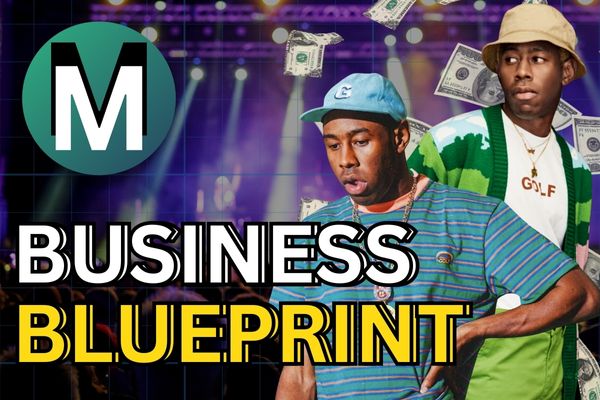
The Tyler Blueprint
So what’s the lesson? Tyler, the Creator built his empire by:
-
Building culture first, then monetizing it.
-
Using music as a launchpad, not the end goal.
-
Turning Odd Future merch into Golf Wang, a global fashion brand.
-
Owning and curating his own festival, Camp Flog Gnaw.
-
Diversifying into acting, directing, and brand deals.
-
Protecting his catalog for long-term wealth.
Tyler never followed the traditional rapper path. He built his own lane—and monetized it on his terms.
Conclusion
Tyler, the Creator has grown from a rebellious skater kid into a cultural architect. Odd Future gave him the foundation. His music provided the launchpad. Golf Wang and Camp Flog Gnaw turned him into a mogul. And with acting and ownership strategies, he’s only expanding further.
In 2025, Tyler isn’t just a genius artist—he’s a case study in creative entrepreneurship.
Enjoyed this breakdown? Explore more deep dives into music, money, and the moves that shape the industry. Discover stories behind the hits and the strategies that make them.