Rick Ross’s Real Money: The Wingstop Business Behind the Rap
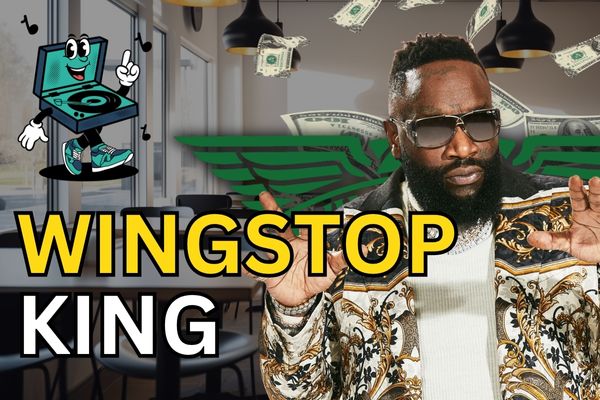
Rick Ross has always called himself “The Biggest Boss.” And for most rappers, that’s just a nickname. But when it comes to Ross, it’s a business title. For years, he’s rapped about lemon pepper wings, Belaire bottles, and lavish mansions — but unlike most artists, Ross didn’t just talk about it. He built it.
Today, Rick Ross isn’t just a rapper. He’s a restaurant mogul, liquor brand ambassador, real estate investor, and published author. From hustling in Miami to hustling chicken wings across the country, Ross has created one of the most unique business empires in hip-hop. And at the center of it all is one thing: his love for Wingstop.
This is the story of how Rick Ross turned a simple passion into a multimillion-dollar blueprint.
From Hustlin’ to the Biggest Boss
William Leonard Roberts II — better known as Rick Ross — made his name in 2006 with Port of Miami. His breakout single Hustlin’ became an anthem, and that “every day I’m hustlin’” hook turned into a lifelong mantra. The luxury, the Maybachs, the suits, the champagne — it wasn’t just fantasy; it was a strategy.
That image of “The Boss” gave him leverage when he launched Maybach Music Group (MMG) in 2009, signing acts like Meek Mill and Wale. By 2012, he was listed on Forbes’ “Hip-Hop Cash Kings,” earning $9 million in one year. But even while his music career peaked, Ross was thinking ahead. He knew music money had limits. He needed something lasting.
The Wingstop Connection
Long before the fame, Ross tried Wingstop for the first time in the early 2000s — and he was hooked. Especially on the lemon pepper wings. Fans began associating Ross with the flavor after he started name-dropping it in songs, turning an inside joke into brand identity.
By 2011, he took it a step further and bought his first Wingstop franchise in Memphis, Tennessee. The timing couldn’t have been better. In 2010, Wingstop had just 450 locations nationwide and about $200 million in annual sales. By 2020, those numbers ballooned to more than 1,500 restaurants and $1.4 billion in revenue.
Ross had bought in early, and as Wingstop grew, so did his personal empire. But the genius wasn’t just buying franchises — it was using his music as marketing. Every time he rapped about lemon pepper wings, it was free advertising. Tracks like Lemon Pepper Freestyle with Drake in 2021 were practically commercials. That authenticity made Ross one of the most effective brand ambassadors in hip-hop history.
Building the Empire: 25+ Wingstop Locations
Ross didn’t stop at one store. By 2021, he owned at least 25 Wingstop franchises across the U.S., primarily in the South. The math speaks for itself: the average Wingstop brings in roughly $1.5 million a year in gross sales. Across 25 stores, that’s around $37 million in systemwide sales.
Franchise owners typically keep 5–10% in net profit after royalties and expenses. That means Ross is likely earning between $1.5 million and $3.5 million a year—just from chicken wings. That’s steady, recurring revenue that flows in whether or not he drops another album.
And he’s turned it into a family business. In 2021, Ross made headlines for gifting his 16-year-old son a Wingstop franchise — a symbolic move showing how he’s passing down ownership and teaching generational wealth in real time.
Expanding the Menu: Checkers, Belaire, and Beyond
Chicken wings were only the start. In 2017, Ross purchased multiple Checkers restaurants in Miami — a full-circle moment since he grew up walking past them when he couldn’t afford to eat there. Owning them wasn’t just business; it was personal redemption.
He also became the face of Luc Belaire Rosé, helping the French sparkling wine explode in popularity. Today, Belaire sells over 2 million bottles a year worldwide, with Ross’s influence in hip-hop culture being a major driver.
Then came Rap Snacks. Partnering with the brand, Ross launched Rozay Cheddar chips, joining artists like Migos and Lil Baby who turned snack aisles into marketing gold.
None of these were random endorsements. Ross built an ecosystem: wings, fries, champagne, and chips — affordable luxuries people buy over and over again.
Real Estate and The Promise Land
Ross’s business sense extends beyond food. In 2014, he purchased Evander Holyfield’s former mansion in Fayetteville, Georgia for $5.8 million. The estate — dubbed The Promise Land — has 109 rooms, a 350,000-gallon pool, and sits on 235 acres, making it one of the largest homes in the U.S.
But Ross didn’t just buy a mansion to flex. He turned it into an income-producing asset, renting it out for film productions, including Coming 2 America in 2021. In 2022, he announced plans to start a cattle farm on the property — expanding into agriculture and food production.
Even his “flexes” make money.
The Author: The Perfect Day to Boss Up
In 2021, Ross added another title to his résumé: author. His book The Perfect Day to Boss Up became a New York Times bestseller. Part autobiography, part business guide, the book cemented Ross’s image as more than a rapper — as a teacher for aspiring entrepreneurs.
It was another smart move in brand-building. The book extended his message beyond music and added a new revenue stream that aligned perfectly with his “Boss” persona.
The Boss Blueprint
Rick Ross’s success formula isn’t complicated — it’s disciplined.
-
He aligned his passions with profit (he genuinely loved Wingstop before investing).
-
He scaled through franchises, buying into proven systems instead of starting from scratch.
-
He used music as marketing, turning lyrics into cultural advertisements.
-
He diversified smartly — into food, drinks, snacks, real estate, and publishing.
-
He focused on generational wealth, not quick wins.
Even his mansion doubles as a business. Every move serves a purpose, building a brand that operates with consistency and authenticity.
Conclusion
From “every day I’m hustlin’” to “every day I’m franchisin’,” Rick Ross turned rap fame into a business empire. What started as a passion for lemon pepper wings evolved into a multimillion-dollar portfolio spanning Wingstop, Checkers, Belaire, Rap Snacks, real estate, and publishing.
Ross has proven that being “The Biggest Boss” isn’t about the flex — it’s about ownership, scalability, and legacy.
The only question left is: will Rick Ross go down as hip-hop’s greatest food mogul, or will someone else step up to take that crown?
Enjoyed this breakdown? Explore more deep dives into music, money, and the moves that shape the industry. Discover stories behind the hits and the strategies that make them.