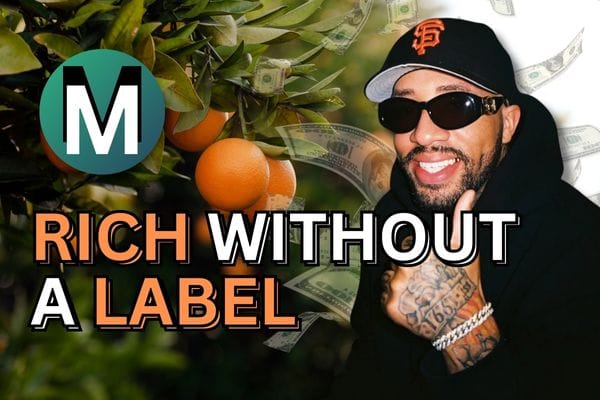
Rappers Who Became Millionaires Without a Label
In the music industry, ownership is everything. It’s what separates artists who just make money from those who keep it.
For decades, record labels held all the power — owning masters, controlling publishing, and taking the lion’s share of profits. But a new wave of rappers proved you don’t need a major deal to build real wealth. You need a business plan, loyal fans, and control of your catalog.
From legends like Curren$y and Tech N9ne to modern stars like Larry June and Russ, these artists show that financial freedom in hip-hop isn’t about chart positions or radio play — it’s about independence.
Curren$y: Consistency Is a Business Model
Curren$y’s path started under majors (No Limit, then Young Money), but the control he wanted wasn’t there. In the late 2000s he made the call that defined his career: go fully independent.
In 2011 he launched Jet Life Recordings on a simple philosophy — stay consistent, stay connected, never stop releasing. Since then he’s dropped 40+ projects, kept ownership, and built an ecosystem: tours, vinyl, limited drops, Jet Life apparel that routinely sells out.
Beyond music, he’s leaned into real estate and a vintage car collection that doubles as brand content. He’s not the mainstream chart-topper — he’s the financially free, self-sustaining artist many wish they were. Estimated net worth: $5–7M, but the key is that it’s his money.
Larry June: Independence, but Make It Luxury
Larry June made indie look upscale. After a brief major stint, he went fully independent with The Freeminded / The Orange Print LLC and never looked back.
His playbook: multiple projects a year, tight producer partnerships (Cardo, The Alchemist), and a lifestyle brand built on mantras like “Good Job, Larry” and “Numbers.” His merch rivals streetwear labels; the Honeybear Boba shop in San Francisco brings the brand offline.
Owning his masters means every stream, vinyl, and ticket flows back to his imprint. Reports put his independent income well into seven figures annually; net worth estimates $3–5M — and growing quietly, project by project.
Tech N9ne: Indie Like a Fortune 500
Before independence was cool, Tech N9ne was running it like a corporation. In 1999 he co-founded Strange Music with Travis O’Guin and built an in-house machine: touring, merch, studios, distribution.
By the early 2010s, Strange was one of the most profitable indie labels in the world, peaking at $20M+ in annual revenue. Tech frequently played 200+ shows a year, sold VIP experiences, and kept margins via direct-to-fan sales. Cumulative Strange revenue has reportedly topped $100M. Tech remains one of the richest independent rappers (estimated $15–20M), all built outside the majors.
Chance The Rapper: Streaming Leverage, Zero Masters Lost
When Chance The Rapper won three Grammys in 2017 for Coloring Book, he became the first artist to win without selling a physical copy — and did it independently.
He turned down labels after Acid Rap, used free distribution to build a fanbase, and monetized with touring, merch, and brand partnerships (including a reported $500K Apple Music exclusivity window). Deals with Kit Kat, Nike, Doritos — all while keeping ownership. Estimated net worth by 2020: ~$25M, powered by leverage, not advances.
Russ: The Bedroom-to-Balance-Sheet Blueprint
Polarizing? Often. Effective? Absolutely. Between 2011–2016, Russ uploaded 80+ self-produced songs to SoundCloud, amassing an audience before any deal. By the time he partnered with Columbia (2017), it was a joint venture — he kept his masters.
In 2018, Forbes pegged his monthly streaming at $15K–$20K (before shows/merch). Today, with tours, consistent releases (DIEMON imprint), and full ownership of publishing and masters, estimates place his net worth around $10M — built on control and consistency.
Nipsey Hussle: Ownership as a Movement
Few embodied ownership like Nipsey Hussle. He launched All Money In in 2010, turned down majors for years, and when he finally partnered with Atlantic for Victory Lap (2018), it was a JV — masters retained.
His model was local and literal: “Own the block you rap about.” Real estate across South Central L.A., The Marathon Clothing, investments in tech and co-working. In 2013, he sold 1,000 copies of Crenshaw at $100 each — sold out in <24 hours (Jay-Z bought 100). It was more than a bag; it was a statement on value and direct-to-fan commerce. Estimated net worth at passing: $8–10M, with a brand and philosophy that continue compounding.
The Common Thread: Ownership Over Optics
-
Masters & Publishing: Keep them, or structure deals where you recoup leverage.
-
Direct-to-Fan Sales: Vinyl, limited capsules, VIP shows, memberships — high margin, high loyalty.
-
Relentless Output: Catalog compounds. Frequency beats virality.
-
Brand Extensions: Coffee/boba, apparel, autos, real estate — businesses that fit the story.
-
Smart Partnerships: JVs and distribution > traditional deals. Keep control of the core.
Final Word: The Indie Millionaire Playbook
Curren$y and Larry June proved consistency and lifestyle branding can print money. Tech N9ne showed touring and merch can out-earn radio. Chance and Russ leveraged streaming without surrendering ownership. Nipsey turned independence into a philosophy, then a community.
Different paths, same principle: control what you create, and your success becomes permanent. In an era where majors still dominate the charts, these artists built multi-million-dollar empires by design — not by luck.
This is Money & Music — where we don’t just talk about the songs; we break down the business behind them.
Enjoyed this breakdown? Explore more deep dives into music, money, and the moves that shape the industry. Discover stories behind the hits and the strategies that make them.